Application Materials: Resume & Curriculum Vitae (CV)
Purpose of Application Materials
Application materials give you the opportunity to market yourself to a potential employer by connecting the dots between your experiences and the position they are trying to fill. They also provide space to demonstrate industry knowledge, align with employer values, and highlight your most marketable qualifications. Your documents should be well-organized, carefully proofread, and tailored with your audience in mind.
Types of Application Materials
The most commonly requested application materials for job or internship opportunities are a resume or curriculum vitae (CV) and a cover letter. While both resumes and CVs are used to apply for opportunities, they are different types of documents, so it is important to consider which is most appropriate for your field and interests.
Resume
Purpose: Outlines your personal, educational, and world-related experiences in relation to a position
Position Type: Business, non-profit, technical fields, and industry/non-academic positions
Length: One or two page document
Focus: Strengths and qualifications for a specific position
Curriculum Vitae (CV)
Purpose: Comprehensive summary of your education and professional experiences, including publications, presentations, professional activities, etc.
Position Type: Faculty, research, clinical, scientific positions, some graduate school applications, or when specifically requested
Length: Two or more pages in length
Focus: Comprehensive biographical statement
At the undergraduate level, the CV is typically more of a hybrid of a resume and CV, as you will likely not have the content for many of the suggested CV categories just yet. Wondering which document you should use? Go with a resume for industry jobs/internships and a CV for research and academic roles.

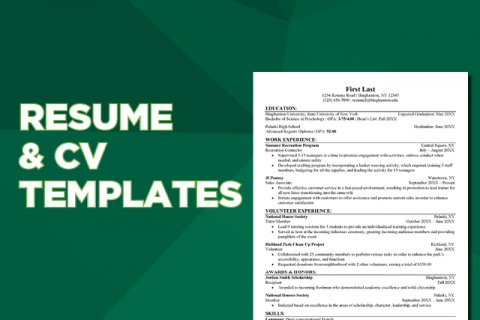
Download any of our approved resume/CV templates to help you get started with creating your resume or CV! Simply download the Word document for any template you would like to use and begin editing the document! Once you have created your resume or CV, schedule an appointment with a Fleishman Center staff member in hireBING for feedback!
Resume & Curriculum Vitae (CV) Tips
Organizing Your Document
The organization of your document can help to highlight your most relevant experiences, signal interest in the field, and improve the overall readability for your intended audience. Splitting up your experience using section headings is one of the most popular ways to organize your resume or CV. Group your experiences within sections based on themes, knowing that you may update them based on your individual experience, the position, or the employer.
Common Section Headings for Resumes
- Leadership Experience
- Internship Experience
- Volunteer & Involvement
- Relevant Experience
- Project Experience
- Presentations
- Research Experience
- Skills & Certifications (focus on hard skills only)
Common Section Headings for CVs
- Research
- Teaching
- Publications
- Presentations
- Professional Experience
- Grants & Fellowships
- Certifications
- Professional Affiliations & Service
Ultimately, your document should work for you, so choose section headings that best align with your background and experience. Within each section, list your experiences in reverse chronological order, starting with your most recent role and working backward.
Create a master resume: a polished document that includes your full work history, campus involvement, and community experiences to use as a foundation when applying for positions. From this document, you can easily pull relevant experiences to create more tailored versions that are personalized for each employer and role.
Writing Strong Bullet Points
Bullet points articulate the skills you’ve developed through your experiences and clearly connect them to the qualifications employers are seeking. Your bullet points should emphasize impact, highlighting your personal skills and contributions.
Bullet Point Formula:
Action Verb, What you did, How you did it, Why it was important/Outcome
- Transferable skill: Analyzing data
- Supporting experience: Student Research Assistant
- Resume bullet point: Analyzed outcomes data from three academic journals by synthesizing and comparing key findings to inform the development of a research proposal on the impact of social media use on college student mental health
- Begin with a strong action verb that describes the transferable skill you would like to highlight. Avoid passive language such a “Responsible for” or “Assisted”
Administered
Anticipated
Commissioned
Determined
Developed
Devised
Evaluated
Forecasted
Identified
Planned
Prepared
Formulated
Prioritized
Researched
Revised
Strategized
Studied
Tailored
Acquired
Activated
Adjusted
Allocated
Arranged
Assembled
Assessed
Cataloged
Classified
Collected
Committed
Confirmed
Coordinated
Customized
Delegated
Designated
Designed
Established
Facilitated
Implemented
Incorporated
Instituted
Issued
Logged
Obtained
Ordered
Procured
Programmed
Recruited
Retrieved
Scheduled
Secured
Selected
Simplified
Suggested
Tracked
Acted
Administered
Completed
Conducted
Displayed
Distributed
Exercised
Forwarded
Input
Installed
Operated
Performed
Processed
Produced
Proved
Shipped
Sold
Transacted
Adjusted
Analyzed
Certified
Chaired
Controlled
Developed
Directed
Discovered
Elected
Encouraged
Established
Examined
Explored
Founded
Inspected
Inspired
Judged
Maintained
Measured
Modified
Monitored
Officiated
Overhauled
Oversaw
Pioneered
Prohibited
Promoted
Refined
Regulated
Reviewed
Scrutinized
Stimulated
Strengthened
Supervised
Trained
Updated
Alleviated
Analyzed
Brainstormed
Collaborated
Conceived
Created
Deciphered
Detected
Diagnosed
Engineered
Explained
Foresaw
Formulated
Found
Investigated
Recommended
Remodeled
Repaired
Revamped
Revitalized
Satisfied
Solved
Synthesized
Theorized
Adapted
Addressed
Clarified
Communicated
Composed
Concluded
Consulted
Convinced
Corresponded
Critiqued
Dedicated
Defined
Deliberated
Demonstrated
Drafted
Edited
Educated
Explained
Extracted
Greeted
Highlighted
Illustrated
Improvised
Indicated
Informed
Instructed
Interpreted
Interviewed
Justified
Lectured
Marketed
Mediated
Moderated
Negotiated
Persuaded
Presented
Publicized
Questioned
Referred
Reinforced
Reported
Represented
Shaped
Specified
Spoke
Submitted
Suggested
Summarized
Supplemented
Surveyed
Synthesized
Systematized
Taught
Tested
Translated
Transmitted
Verified
Welcomed
- Use past tense verbs for positions you have completed and present tense verbs for current positions
- Quantify when possible (percentages, dollar amounts, frequency, etc..)
Cover Letter Tips & Outline
Purpose of a Cover Letter
Resumes should be tailored to the intended audience, but cover letters are where applicants can explicitly connect the dots between their experiences and the opportunity they are pursuing. A strong cover letter generates interest in you as a candidate, clearly demonstrates how your skills and experiences align with the position, and motivates the reader to review your resume and invite you for an interview. When given the opportunity to submit a cover letter, even if it is optional, it is in your best interest to take advantage of it and write a unique letter that highlights your skills and demonstrates your interest in the position.
Steps To Writing A Strong Cover Letter
Step 1:
Learn more about the organization.
What is the mission and goals? What are you interested in working for them specifically?
Step 2:
Review the position description carefully.
Highlight keywords and required skills.
Step 3:
Write down examples from your own experience that showcase the skills and keywords identified in the position description.
Consider work experience, academics, extracurriculars, and more!
Step 4:
Select 2-3 concrete examples to write about that demonstrate your qualifications.
Be specific about how they connect to the position you are applying for.

Utilize our Cover Letters resource for in-depth instructions on how to write a cover letter, best practices, and samples. Once you have developed a draft, schedule an appointment with a Fleishman Center staff member in hireBING for feedback!